Whatsapp: +86 15001050898 Email : collin@runingpower.com / daisy@runingpower.com

AGV & Robotics Batteries — Power That Never Quits
Runing Power AGV batteries deliver up to 75A continuous discharge with RS485/CAN bus integration, metal casing for vibration resistance, and proven performance from -20°C to +60°C. Engineered for 24/7 automated factories, cold storage, and high-load robotic applications.


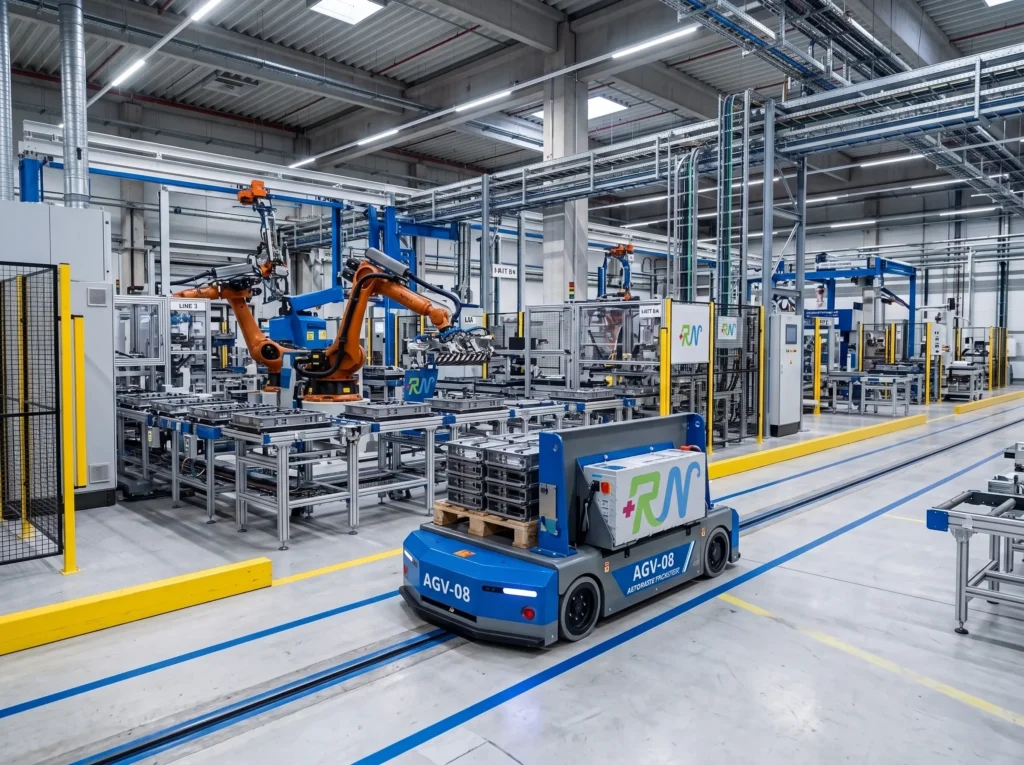
The Growing Demand for AGV Lithium Batteries
The global AGV and AMR lithium battery market was valued at US$ 1,326 million in 2025 and is projected to reach US$ 3,549 million by 2032, growing at a CAGR of 15.1%[reference:6][reference:7]. This rapid growth is driven by the accelerated replacement of lead-acid batteries in existing fleets, the increasing penetration of automation in manufacturing and logistics, and the growing demand for localized battery solutions in overseas markets[reference:8].
Runing Power has been at the forefront of this transformation since 2017. With 15+ years of lithium expertise, 4,000+ m² of production capacity, and 600+ global projects, we deliver AGV batteries that meet the most demanding industrial requirements — from 24/7 manufacturing lines to -35°C cold storage warehouses.
AGV Operating Characteristics & Battery Requirements
AGVs operate under three demanding conditions that define battery performance requirements
Continuous, Long-Duration Operation
AGV systems often operate for multiple shifts or continuously, 24/7. This requires an industrial-grade battery that maintains steady voltage, controlled heat, and consistent performance over long periods.
Frequent Cycling & Instant High-Current Demands
AGVs constantly accelerate, lift, and stop — facing instant high-power spikes repeatedly. Only batteries that tolerate high discharge rates, operate in a wide temperature range, and support fast charging are suitable.
Severe Internal Space Constraints
AGV design prioritizes compact size and high payload-to-weight ratio. The space reserved for the battery is minimal and often irregularly shaped, necessitating high energy density and customizable form factors.
Why Runing Power AGV Batteries?
Engineered for the toughest industrial demands
High Discharge Rate
Continuous discharge up to 75A (48V 75Ah model), pulse up to 150A (48V 100Ah model) — no voltage sag under heavy loads.
Multi-Protocol BMS
Supports RS485 (Modbus RTU), CAN bus (CANopen/J1939), and analog output — plug-and-play with Siemens, Beckhoff, KUKA, SICK. CAN bus is preferred in most AGV projects for its high-speed, deterministic communication.
Rugged Metal Casing
Welded metal housing with gasket-sealed lids — vibration-resistant and IP65-rated for harsh industrial environments.
Wide Temperature Range
Reliable operation from -20°C to +60°C. Low-temperature models support discharge down to -35°C for cold storage.
Long Cycle Life
>2000 cycles at 80% DOD — 4–6× longer than lead-acid[reference:14]. Zero watering, zero equalization, zero terminal cleaning.
48h Custom Engineering
Any shape, any voltage (24V–1000V), any protocol — 48-hour design-to-sample for non-standard applications.
Runing Power AGV batteries are engineered to outperform traditional lead-acid solutions across every key metric
| Metric | Lead-Acid Battery | Runing Power LiFePO₄ | Improvement |
|---|---|---|---|
| Energy Density | 30–50 Wh/kg | 100–150 Wh/kg | 2–3× higher |
| Full Charge Time | 6–8 hours | 1–2 hours | 4–6× faster |
| Cycle Life | 300–500 cycles | >2,000 cycles @80% DOD | 4–6× longer |
| Depth of Discharge | ~70% recommended | >90% usable | More usable capacity |
| Weight (48V 100Ah equivalent) | 350–400 kg | ~20 kg | 85%+ lighter |
| Maintenance | Weekly watering, equalization, terminal cleaning | Zero maintenance | 100% eliminated |
| Lifespan (daily fleet service) | 18–24 months | 5–7 years | 3× longer |
Standard models from the Runing Power AGV battery portfolio. All data sourced from actual product specifications. Custom configurations available upon request.
| Model | Voltage | Capacity | Energy | Max Continuous Discharge | Communication | Operating Temp. |
|---|---|---|---|---|---|---|
| 48V 28Ah | 48V | 28Ah | 1,440Wh | 30A | RS485 / CAN / Analog | -20℃ ~ +60℃ |
| 48V 30Ah | 48V | 30Ah | 1,440Wh | 30A | RS485 / CAN / Analog | -20℃ ~ +60℃ |
| 48V 34Ah | 48V | 34Ah | 1,632Wh | 34A | RS485 / CAN / Analog | -20℃ ~ +60℃ |
| 48V 40Ah | 48V | 40Ah | 2,048Wh | 60A | RS485 / CAN / Analog | -20℃ ~ +60℃ |
| 48V 50Ah | 48V | 50Ah | 1,920Wh | 40A | RS485 / CAN / Analog | -25℃ ~ +55℃ |
| 48V 75Ah | 48V | 75Ah | 3,600Wh | 75A | RS485 / CAN / Analog | -20℃ ~ +60℃ |
| 48V 100Ah | 48V | 100Ah | 4,800Wh | 150A (pulse) | RS485 / CAN / Analog | -20℃ ~ +60℃ |
| 24V 40Ah | 24V | 40Ah | 1,024Wh | 40A | RS485 / CAN / Analog | -20℃ ~ +60℃ |
| 24V 60Ah | 24V | 60Ah | 1,440Wh | 60A | RS485 / CAN / Analog | -20℃ ~ +60℃ |
| 24V 80Ah Low-Temp | 24V | 80Ah | 1,920Wh | 50A | RS485 / CAN / Analog | -35℃ ~ +60℃ |
| 28.8V 100Ah Low-Temp | 28.8V | 100Ah | 2,880Wh | 100A | RS485 / CAN / Analog | -35℃ ~ +60℃ |
| 48V 40Ah Low-Temp | 48V | 40Ah | 1,920Wh | 60A | RS485 / CAN / Analog | -25℃ ~ +55℃ |
| 48V 30Ah Low-Temp | 48V | 30Ah | 1,440Wh | 20A | RS485 / CAN / Analog | -30℃ ~ +55℃ |
Custom voltages (24V–1000V), capacities, and communication protocols available.
Engineering Behind the Power
Intelligent BMS Communication
Runing Power AGV batteries feature a multi-protocol Battery Management System (BMS) that ensures seamless integration with major AGV controllers. The BMS supports CAN bus (CANopen/J1939) for deterministic real-time communication — the preferred protocol for most AGV and AMR projects due to its high-speed, reliable data transmission. RS485 (Modbus RTU) provides cost-effective, long-distance communication for legacy systems and larger AGVs. Analog output (0–5V / 4–20mA) enables basic monitoring for simpler integrations. Dual-channel redundancy for safety-critical signals ensures SOC accuracy above 95% through advanced coulomb counting algorithms.
Built for Industrial Vibration
AGVs operate on uneven warehouse floors, loading docks, and outdoor surfaces. Runing Power batteries feature welded metal casings with gasket-sealed lids, internal shock-absorbing cell mounting, and IP65-rated sealing for dust and moisture resistance. Every battery undergoes 100% full charge-discharge aging testing before shipment, ensuring consistent quality and reliability.
Low-Temperature Performance
Standard AGV batteries lose 20–40% capacity below 0°C. Runing Power low-temperature models (28.8V 100Ah, 24V 80Ah, 48V 40Ah Low-Temp) maintain >85% capacity at -20°C and reliable discharge down to -35°C. Self-heating BMS technology activates when cell temperatures drop below safe thresholds — no external heaters required.
High-Rate Discharge & Opportunity Charging
Automated material handling demands sustained high-current output. Runing Power AGV batteries deliver up to 75A continuous (48V 75Ah model) with pulse capability up to 150A (48V 100Ah model). LiFePO₄ chemistry ensures stable voltage plateau under load — no voltage sag during simultaneous motor operation and sensor data transmission. AGVs use a strategy called Opportunity Charging — adding power during every short stop or idle time. LiFePO₄ batteries support this with minimal impact on lifespan, unlike lead-acid batteries that suffer from sulfation.
How to Choose the Right AGV Battery
Selecting the optimal AGV battery requires evaluating five key factors.
Duty Cycle & Runtime
Calculate your AGV’s average and peak power consumption. Match capacity (Ah) to your shift duration plus a safety margin. Runing Power offers 28Ah to 100Ah+ configurations.
Charging Window
If your operation supports long off-shift charging, lead-acid can remain workable. If you need short charge windows with opportunity charging, lithium becomes operationally essential.
Communication Integration
Ensure BMS communication matches your AGV controller. Runing Power supports CAN bus, RS485, and analog output.
Environmental Conditions
Consider operating temperature, humidity, and vibration. Runing Power offers standard (-20℃ to +60℃) and low-temperature (-35℃ to +60℃) variants with IP65 protection.
Total Cost of Ownership (TCO)
While LiFePO₄ batteries have higher upfront costs, they deliver 4–6× longer lifespan, 4–6× faster charging, zero maintenance, and 85%+ weight reduction compared to lead-acid. A 96-cart fleet upgrade demonstrated 70% lower maintenance cost and doubled runtime.
Trusted in Real-World Deployments
Automotive Factory AGV Fleet
30 AGVs upgraded to 48V 40Ah high-rate batteries with CAN bus. 3+ year battery life. AGV productivity increased 15%.
German Cold Storage AGV Fleet
20 AGVs at -25°C with 24V 80Ah low-temperature batteries. 99.5% uptime over two winter seasons.
State Grid Power Monitoring
Custom 48V 100Ah batteries with remote monitoring. 5+ years strategic cooperation. Zero safety incidents.
What is the maximum continuous discharge current of Runing Power AGV batteries?
Runing Power AGV batteries deliver up to 75A continuous discharge (48V 75Ah model), with pulse capability up to 150A (48V 100Ah model).
Which communication protocols do Runing Power AGV batteries support?
Our AGV batteries support RS485 (Modbus RTU), CAN bus (CANopen/J1939), and analog output (0–5V / 4–20mA).
What is the operating temperature range of Runing Power AGV batteries?
Runing Power AGV batteries operate from -20°C to +60°C, with low-temperature models supporting discharge down to -35°C.
How many cycles do Runing Power AGV batteries last?
Runing Power AGV LiFePO₄ batteries deliver >2,000 cycles at 80% depth of discharge — 4–6 times longer than lead-acid batteries.
Can Runing Power custom design AGV batteries for non-standard applications?
Yes. Runing Power offers 48-hour design-to-sample for custom AGV batteries. We can accommodate non-standard voltages (24V–1000V), irregular shapes, and specialized communication protocols.
Industry Resources:
Ready to Power Your AGV Fleet?
Tell us your voltage, capacity, and communication requirements — we’ll design an AGV battery solution that keeps your automated operations running 24/7.
WhatsApp: +86 180 1558 4677 · Tech: tech@runingpower.com