Whatsapp: +86 15001050898/+86 19152917263 Email : martin@runingpower.com / daisy@runingpower.com

AGV & RGV Battery Engineering
How to Choose a Low-Temperature LiFePO4 Battery for AGV and RGV Systems
A practical guide to temperature limits, battery capacity, smart BMS protection, charging strategy, CAN/RS485 communication and enclosure design for automated vehicles working in cold storage and winter environments.
Published October 21, 2026 · By RUNING POWER Engineering Team · Approximately 8 minutes

Automated guided vehicles and robotics systems are increasingly used in cold-storage warehouses, outdoor logistics centers, automated production lines and temperature-sensitive material-handling systems. Rail-guided vehicle operators can also review our dedicated RGV battery product series.
A battery pack that performs well at room temperature may not deliver the same usable energy, peak power or charging performance below 0°C. Selecting a pack only by nominal voltage and ampere-hours can therefore result in shorter runtime, excessive voltage drop, unexpected protection events and reduced productivity.

Why Low Temperature Changes Battery Performance
As temperature falls, electrochemical reactions inside a lithium-ion battery slow down. Electrolyte conductivity decreases and charge-transfer resistance rises. In an AGV, the result may be lower usable capacity, weaker peak-power response and a larger voltage drop during acceleration or lifting.
Charging needs even more careful control. An unsuitable charge current at low cell temperature can increase the risk of lithium plating, which may cause permanent capacity loss and shorten service life. The charge strategy must therefore follow the validated cell, BMS and pack specifications—not a generic temperature claim. Published research on large-format LiFePO4 batteries similarly identifies low-temperature charging current and voltage limits as important aging factors.[1]
Engineering note:
“Operates at -30°C” is incomplete unless the supplier separately states the charging temperature, discharging temperature, current limits and test conditions.

Define the Real Operating Conditions
Start with the application rather than the battery catalogue. Confirm the minimum ambient and cell temperatures, exposure time, load profile and charging location.
- Lowest ambient and expected battery-cell temperature
- Minimum charging and discharging temperatures
- Time spent continuously inside the cold zone
- Movement between cold and warm areas and the resulting condensation risk
- Vehicle load, travel speed, lifting cycles and gradients
- Charging windows and required runtime per shift
An AGV that remains in a -25°C freezer throughout the shift requires a different solution from a vehicle exposed to -25°C for only a short outdoor transfer.
Size Capacity and Power Correctly
Nominal energy is only the starting point. The pack must also support peak loads created by acceleration, lifting, steering, climbing and simultaneous auxiliary equipment. Low temperature can reduce usable energy and increase voltage sag, so the engineering margin should be based on the actual duty cycle.
| Input | Why it matters |
|---|---|
| Continuous and peak current | Determines cell, busbar, BMS and connector current capability. |
| Runtime per shift | Defines usable energy rather than nominal Ah alone. |
| Lowest cell temperature | Affects available capacity, voltage response and allowable current. |
| Charging opportunity | Determines whether opportunity charging, battery heating or higher capacity is appropriate. |
| Battery compartment | Controls enclosure dimensions, heat retention and service access. |

Specify a Smart Low-Temperature BMS
The battery management system should monitor cell voltage, pack current, battery temperature and state of charge while controlling overcharge, over-discharge, overcurrent, short circuit and temperature-related protection.
For cold applications, the BMS should have separate charge and discharge temperature thresholds. If heating is required, the engineering team must define the heater power source, activation and stop temperatures, insulation, warm-up time and fail-safe logic.

Separate Charging and Discharging Limits
A battery may be capable of discharging at a low temperature while requiring a warmer cell temperature before charging. Always request separate specifications for:
- Recommended charging temperature and current
- Recommended discharging temperature and current
- Storage temperature
- Heater activation logic, if fitted
- Charger-to-BMS interlock and communication
When the AGV must recharge inside a freezer, the solution may require integrated heating, insulation, a temperature-controlled charging station or a validated reduced-current charging strategy.
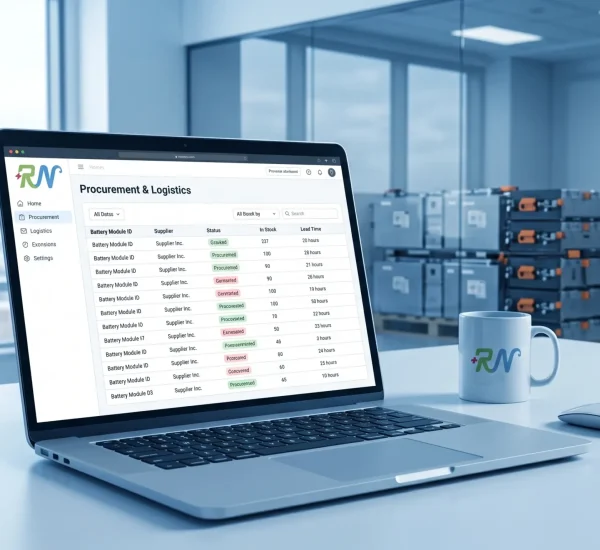
Confirm CAN or RS485 Communication
Modern AGVs and RGVs often exchange battery status with the vehicle controller and charger. Depending on the project, the pack can report state of charge, voltage, current, cell temperature, alarms, charging status and fault information.
Provide the protocol document, baud rate, message definitions, termination requirements and connector pinout before prototype production. RUNING POWER supports customized CAN and RS485 integration for compatible industrial control systems.
Select the Enclosure and Connectors
Cold-storage and outdoor environments can combine moisture, condensation, vibration and mechanical shock. Evaluate enclosure material, sealing requirement, anti-condensation design, mounting method, service access, lifting points and cable direction.
Power and charging connectors must be rated for the validated continuous and peak currents. Signal connectors should prevent incorrect mating and remain reliable under vibration and repeated maintenance.
Validate the Pack Under Real Duty Cycles
Do not approve a cold-environment battery from a room-temperature capacity test alone. Prototype validation should include low-temperature discharge capacity, voltage drop under peak load, heating time, charging interlock, charger compatibility, communication, connector temperature rise and vehicle duty-cycle testing.
Selected RUNING POWER battery systems can be engineered for discharge in environments down to -40°C, subject to cell selection, current, pack construction and project validation. This is a custom battery engineering capability—not a universal rating for every model.
Why Use a Custom Industrial Battery Pack?
A custom pack allows the cell configuration, smart BMS, communication, enclosure, connector and thermal-management strategy to be designed as one system. This reduces integration risk and provides more dependable performance than selecting an off-the-shelf battery by voltage and capacity alone.
Explore our AGV and robotics battery solutions, review our custom LiFePO4 battery capabilities, or browse the technical library.
Technical References
- Low-temperature aging and lithium deposition in large-format LiFePO4 batteries, Journal of Power Sources.
- Research progress on the low-temperature performance of LiFePO4 batteries, Carbon Neutralization.
- Electric Vehicle and Charging, National Renewable Energy Laboratory.
Planning an AGV or RGV Project for a Cold Environment?
Send us your voltage, capacity, minimum charge and discharge temperatures, working current, dimensions, connector and communication protocol. Our engineering team will evaluate a custom LiFePO4 battery solution for your application.
Can a LiFePO4 battery power an AGV at-20°C?
Yes, a properly selected and validated LiFePO4 system can be designed to discharge at -20°C. Usable capacity, voltage response and maximum current may differ from room-temperature values, so the complete pack should be tested under the real vehicle load.
Can an AGV battery be charged below 0°C?
It depends on the cell and pack specification. Low-temperature charging generally needs stricter current and temperature control and may require battery heating. The BMS must
Does every cold-storage AGV need a battery heater?
No. The decision depends on minimum cell temperature, charging location, time spent ind the freezer and required runtime. Heating is more likely to be needed when charging mustd occur in a sub-zero area.
What information is required for a custom AGV battery?
Provide voltage, usable energy, continuous and peak current, duty cycle, minimum charge and discharge temperatures, available space, connectors, charger specifications and the CAN or RS485 protocol.
Does RUNING POWER support CAN and RS485?
Yes. RUNING POWER supports customized CAN and RS485 integration for compatible AGV, RGV, charger and vehicle-control systems. Protocol documents should be provided before prototype development when available.
Hello
Please enter your email address to subscribe.